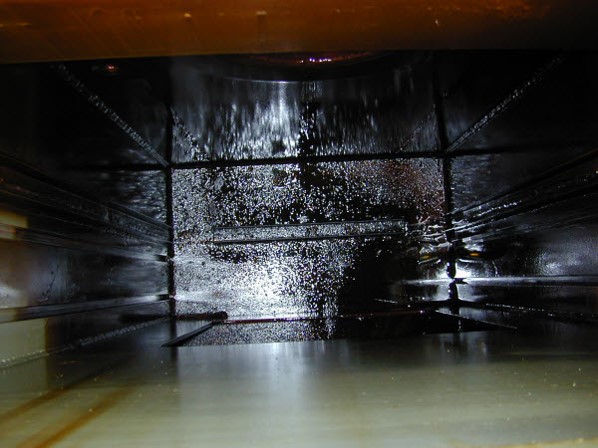
A vacuum dehydrator removes water/moisture and gasses from oils by lowering the vapor pressure. Let’s first explain vapor pressure. The atmosphere, being pulled down by gravity, creates pressure. Atmospheric pressure, at sea level, is 14.7 psi. In other words, the atmosphere has mass and weight. It is this pressure that doesn’t allow bubbles to form and keeps water molecules together in liquid form.
Water molecules move upward against the colliding air molecules from above; this creates pressure. We refer to this as vapor pressure. When atmospheric pressure equals the vapor pressure, water boils. By heating the liquid, the molecules move around quickly and push against the air molecules and that reduces some of the pressure. This makes it easier for the molecules to spread out and form a gas. This is what we call the boiling point. We all know that boiling point of water is 212°F. But, in Denver, Colorado the boiling point of water is 203°F. Why? Denver, known as the mile-high city, is about a mile above sea level, thus less atmopheric pressure pushing down on the water. Keep in mind that different compounds have different vapor pressures, depending on how strong the molecular bonds are.
We can achieve boiling in two ways, by increasing vapor pressure or decreasing the atmosheric pressure. With vacuum dehydration we do both.
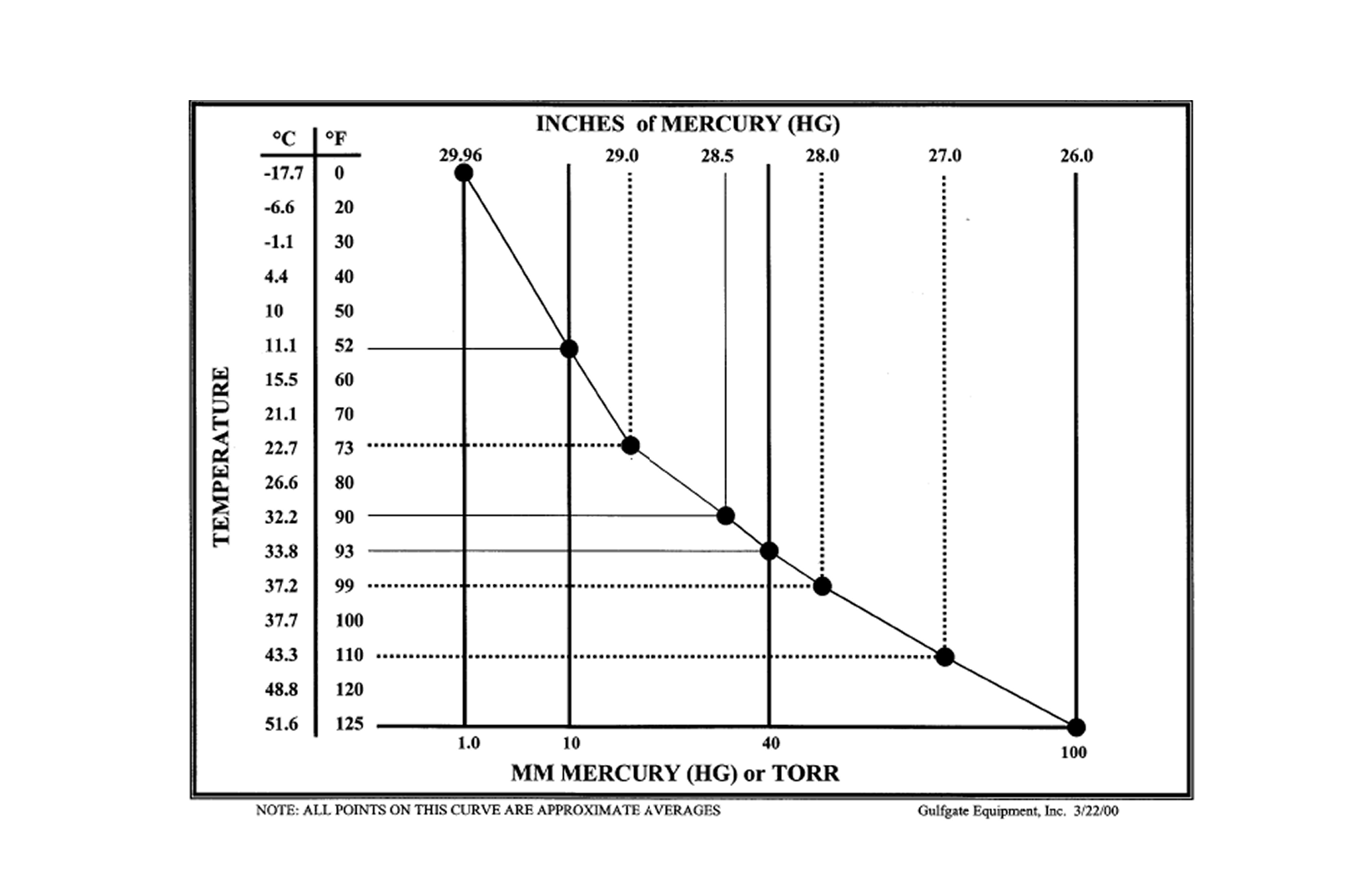
We could simply heat the oil up to 212°F and boil the water out. However, this would be detrimental to the oil and destroy it. So, we decrease the atmosheric pressure so that water and other contaminants can boil at a safe temperature, thus removing contamination and preserving the integrity of the oil. The graph below illustrates the boiling point of water under vacuum conditions. At 26” Hg., water begins to boil at 125°F. By increasing temperature and vacuum pressure, water will boil at a more rapid rate.
A vacuum dehydrator is a skid mounted, piped, filtration system. Oil is pulled in through a heater. We typically heat the oil to 140-160°F as to not damage the oil. Once the oil is heated it flows into the vacuum chamber where we create surface area. The atmospheric pressure is reduced and water (and other contaminants) boil off and are removed. If the oil is extremely wet, we will operate at 25” Hg. As the oil dries out, we increase the vacuum level to pull out more contaminants.
The video below shows how rapid we boil water out of oil. The Pro-Filtration vacuum dehydrator removes water rapidly due to its large vacuum chamber. Oil purifiers with smaller vacuum chambers can sometimes struggle with wet oil. Wet oil produces foam under vacuum conditions. If the vacuum chamber is too small, the foam has no where to go. The systems’ foam detector releases the vacuum pressure in the vacuum chamber, by allowing atmospheric pressure in, in order to reduce the foam. A consequence is that water removal stops while the foam control system is activated. A larger vacuum chamber reduces the frequency at which the foam control system is activated, thus removing more water in a shorter amount of time.
Vacuum dehydrators are used in many industries. We offer water and gas removal solutions for transformer oil, turbine oil, gear oil, morgoil, lubricating oil and hydraulic oils, just to name a few. Systems are designed based on the type of oil we intend to process.